السبت، ٤ نيسان، ٢٠٠٩

Israel Anticipated a Stronger Hamas in Gaza War

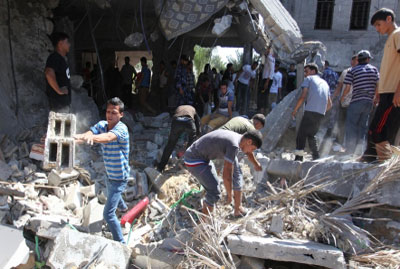
Palestinians clear rubble left from the war in Zaytoun, in southern Gaza City, above. At left, Palestinian rescue workers assist the wounded after an Israeli missile strike on the city's security headquarters and prison in December.
 
 
Palestinians clear rubble left from the war in Zaytoun, in southern Gaza City, above. At left, Palestinian rescue workers assist the wounded after an Israeli missile strike on the city's security headquarters and prison in December. (By Bernat Armangue -- Associated Press)


Gaza Under Fire -   The Washington Post

Washington Post Foreign Service
Saturday, April 4, 2009; Page A06

JERUSALEM -- The small house near Gaza City posed no immediate threat -- there was no sniper fire or evidence it was wired with explosives. But as the Israel Defense Forces approached with plans to position soldiers on either side, Maj. Gur Rosenblat said he still regarded the structure with suspicion, and called in a bulldozer to tear it down.


There was nothing inside.

"A suspicious house between two platoons? I could not leave it," said Rosenblat, a commander in the Israeli reserve. "We took risks to avoid civilian damage, but we tried to make the risks as low as we could. I needed to complete my mission and bring my soldiers back to their families."

The three-week war in the Gaza Strip, launched in late December to undermine the ability of the Islamist Hamas movement and other armed groups to fire mortar shells and rockets into Israel, won broad support among the Israeli public.

But the government has since faced allegations from Israeli and international critics that its forces were too heavy-handed in their attempts to weed out Hamas fighters, weapons stores and other equipment from the densely populated territory of 1.5 million people. Nearly 1,400 Palestinians died in the fighting, Palestinian health officials said; the Israeli death toll was 13.

Interviews with Israeli officers and soldiers who took part in the assault, along with a review of IDF information released during the war, indicate that Hamas fighters did not significantly challenge the assault and that the gunmen who did used tactics and weapons that were largely ineffective. Israeli officials had feared Hamas would deploy Iranian-supplied antitank missiles, for example, but such weapons do not appear to have been used against Israeli forces.

At the same time, Israeli soldiers, determined to avoid the casualties Israel suffered during a 2006 war against the Lebanese Hezbollah movement, moved decisively and quickly against perceived threats, backed by about 2,800 airstrikes.

"During the second Lebanon war, we should apologize for why we lost so many tanks and choppers and soldiers, and now during the Gaza Strip war we should apologize for why we didn't," said an Israeli commander, whom the IDF made available for an interview on the condition that his name not be used. "When you go to fight with 10,000 soldiers and tanks inside a combat area with so much explosives and so many tunnels, you prepare yourself for any kind of surprises. According to this you don't take risks."

Ultimately, Hamas "was less professional than we expected it to be," the commander said, and was unable to cause significant Israeli losses. Israeli soldiers said they were on guard against an extensive list of possibilities, including the gunfire, mortars and suicide bombers that are Hamas's main tools as well as the types of antitank weapons that Hezbollah used with devastating effect in Lebanon.

IDF reports during the war indicate no tanks or armor were lost to Hamas fire during what the military called Operation Cast Lead.

The IDF said Hamas did make widespread use of booby traps and roadside bombs, and described homes with petroleum-soaked walls, mannequins dressed like fighters and rigged to explode, and situations in which Hamas gunfire and movement seemed designed to draw IDF forces down streets littered with explosive traps.

But such tactics largely failed. IDF releases at the time reported one instance of an Israeli soldier being harmed by a booby-trapped house, though an IDF spokesman said there were "a few very near misses."

Israeli soldiers and analysts attribute those outcomes to good intelligence and the use of quick and overwhelming force. IDF officials say Hamas may also have tried to draw the fight into Gaza City and planned a stronger stand there. The IDF stopped its operation at the edge of the dense urban area.

"We did not go there to sign a peace agreement," said a second IDF officer allowed to speak on the condition that his name not be used. "It was a very aggressive operation. But it is very aggressive to launch rockets against Ashkelon or Beersheba," two cities within range of rocket strikes from Gaza. Hamas did use some longer-range missiles of a kind seen only rarely before the war, confirming some Israeli suspicions about its ability to smuggle more sophisticated armaments into Gaza.

According to IDF accounts at the time, six Israeli soldiers died because of Hamas fire -- one was killed during a Hamas mortar attack that struck outside Gaza, another by an antitank missile and four by gunfire. Three civilians were killed by rockets and mortar shells fired into Israel. Four other Israeli soldiers perished in friendly-fire incidents.

"If those are all our casualties, military-wise I think we did a very good job," said Jeff Gafni, an Israeli paratrooper. "We thought we were going to meet really fierce resistance. It did not happen."

In videos posted on the IDF Web site, soldiers with a mortar unit talk of laying down heavy fire to protect infantry positions. "We have yet to encounter significant resistance," one soldier says in an undated video.

"The degree of threat that was posed by Hamas in the last operation was less impressive than the one that was posed by Hezbollah back in 2006, which was the basic reference for everybody. This was perceived to be a similar kind of operation," said retired Brig. Gen. Meir Elran, a senior fellow at Tel Aviv University's Institute for National Security Studies and a consultant to the Israeli commission that reviewed the military's performance in Lebanon. Several top IDF members resigned after the Hezbollah war.

In Gaza, "the emphasis was definitely on minimizing the number of casualties," Elran said.

Noting Hezbollah's use of Russian Kornet and other antitank weapons, a review of Cast Lead by the institute said "there was much concern that Hamas might also make extensive use of these missiles against the IDF. In practice, as far as is known, no use was made of standard antitank missiles during the campaign." Despite concern that Hamas had managed to acquire portable antiaircraft weapons, "in practice no attempt to use such arms was identified," the review said.

Losses on the Palestinian side were substantial -- 1,166 dead, according to Israel's accounting; 1,417 according to the Palestinians'. Israel acknowledges killing at least 295 civilians, saying 709 were fighters -- a ratio it offers as evidence of the care it used. Palestinian officials say about 900 civilians died. Israeli forces destroyed thousands of buildings in what officials said was an attempt to eliminate Hamas's political and military infrastructure, but Palestinians say many civilian structures were demolished, leaving thousands homeless.

Air and artillery assaults struck a devastating blow to Hamas, IDF Maj. Gen. Yoav Galant said in reviewing the operation. "There was nearly not one weapons storage facility, smuggling tunnel and terror operative house that was not hit in the Gaza Strip," he said.

Mindful of allegations that the operation used too much force in dense urban areas, Israeli officials said they often phoned residents before destroying a building to give people time to leave and used percussive charges to warn of an airstrike.

But, with Lebanon as a backdrop amid incessant fire from Hamas, Israeli soldiers say they had to strike hard. "The other side understands that firing rockets is not worth it," Galant said, "and we will make sure it remains that way."


Two Jewish newspapers have altered a photo of Israel's new cabinet, removing two female ministers

Gaza Under Fire - BBC - Two ultra-Orthodox Jewish newspapers have altered a photo of Israel's new cabinet, removing two female ministers.

Limor Livnat and Sofa Landver were grouped with the rest of the 30-member cabinet for their inaugural photo.

But Yated Neeman newspaper digitally changed the picture by replacing them with two men. The Shaa Tova newspaper blacked the women out.

Publishing pictures of women is viewed by many ultra-orthodox Jews as a violation of female modesty.

Other Israeli papers reprinted the altered images next to the original photos, with one headlining it "Find the lady".

The ultra-Orthodox community separates itself from mainstream society through its traditional religious practices and distinctive attire of black hats, coats and sidelocks for the men and long skirts and sleeves for the women.

Restrictions include using only Kosher telephones, and not accessing websites with content deemed inappropriate.

الخميس، ٢٦ شباط، ٢٠٠٩

Video Israel Doesn't Want You to See Video

الأحد، ١٥ شباط، ٢٠٠٩

Gaza women struggle in aftermath of Israeli war

الثلاثاء، ١٠ شباط، ٢٠٠٩

What is Islam?


الأحد، ٨ شباط، ٢٠٠٩

Islam Predicted Scientific Discoveries - Video


الثلاثاء، ٣ شباط، ٢٠٠٩

Family torn apart by Israel's war on Gaza

الخميس، ٢٩ كانون الثاني، ٢٠٠٩

Jews are demanding that Israel cease-fire and call on Obama to save them from themselves!


الأربعاء، ٢٨ كانون الثاني، ٢٠٠٩

Watch This

Read This

Cease fire or not you must expose the Israeli war crimes in Gaza. Stop Justifying Israel's disregard of international law.


Even former Israeli soldiers are calling Israel's actions as "War Crimes", watch: http://www.youtube.com/watch?v=MA3QzmWTp20


See the carnage that you refuse to show: http://tinyurl.com/84krdx


I'm writing to demand that you STOP the Gaza media blackout practiced by your organization.
Your one-sided reporting on the Gaza catastrophe is a form of complicity.


As a media institution you are obligated to report the truth to the world and give a voice to the voiceless.


By not showing the Gaza carnage to the world you're indirectly aided the continued killing of innocent civilians and provided political cover for alleged war crimes by Israel's military against Palestinians.


The alleged genocide targeting the people of Gaza must now be exposed and investigated, but the world will only demand investigations when they know the truth about the recent aggression.


Israel is deliberately blocking the international press from entering Gaza in order to control the narrative by censoring the news.


Don't fail our nation again like you failed us in Iraq.


My friends and I will keep writing you until you break your silence.


I suggest you take the following action:


1. Report the true nature of the violence, suffering and humanitarian crisis


2. Show the images and video from Gaza. Being blocked out by Israel is not an excuse.


Aljazeera is the only TV station with reporters inside Gaza and have offered FREE use of their video to the media worldwide.


USE IT, SHOW IT


3. Stop blaming the victim.


Palestinians are oppressed, occupied and besieged, they're not to blame for this crisis.


4. Equal time for guests/representatives against the Israeli attacks


Read on: http://news.bbc.co.uk/2/hi/middle_east/7828884.stm


Background on crisis by former Israeli soldier: http://www.guardian.co.uk/world/2009/jan/07/gaza-israel-palestine


The United Nations' most senior human rights official said the other night that the Israeli military may have committed war crimes in Gaza, yet you continue to look the other way.